
Skoolia
A school discovery and admissions platform designed to connect families with schools through a simpler enrollment experience.
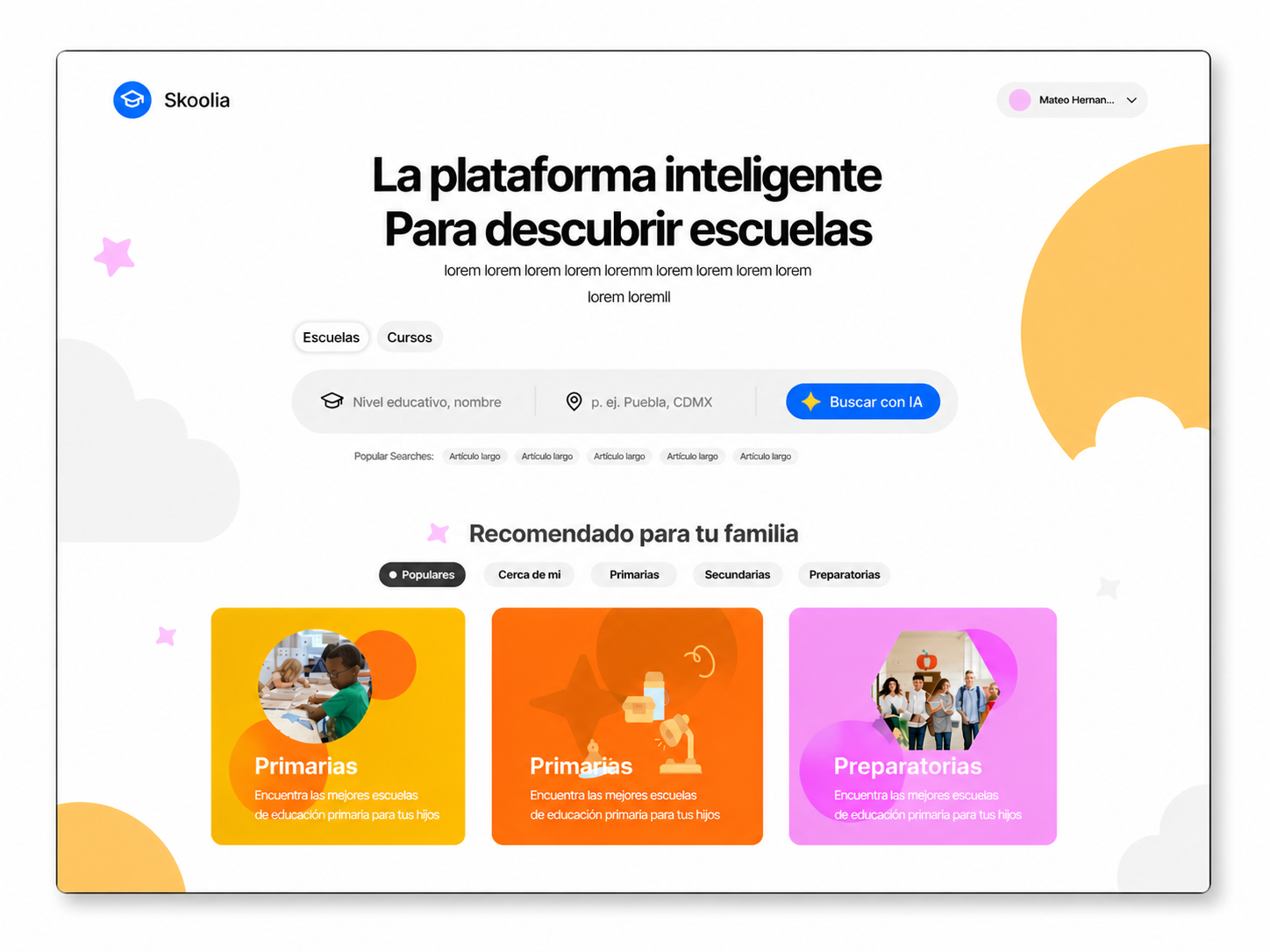
Skoolia was built for Aerobot as a digital platform designed to connect families with schools through a simpler and more centralized admissions experience.
The platform helps parents discover schools, compare options and begin the enrollment process more easily, while giving schools a clearer way to attract and manage prospective families.
At Skoolia, my role was primarily focused on backend engineering, where I led the implementation of the platform’s core application architecture and foundational systems.
I built the authentication layer, helped define the backend architecture using a layered hexagonal approach, and implemented the GraphQL structure used across the platform. Beyond backend ownership, I also contributed to product direction and led the application’s visual design and interface decisions.
Skoolia was designed around a simple problem: finding the right school for a child is still far more difficult than it should be. The process is often fragmented, manual and heavily dependent on word of mouth, making school discovery slow and inconsistent for families.
The product was designed to act as a clearer layer between families and schools — helping parents discover better options through structured search, while giving schools a more direct way to capture interest and begin admissions conversations.
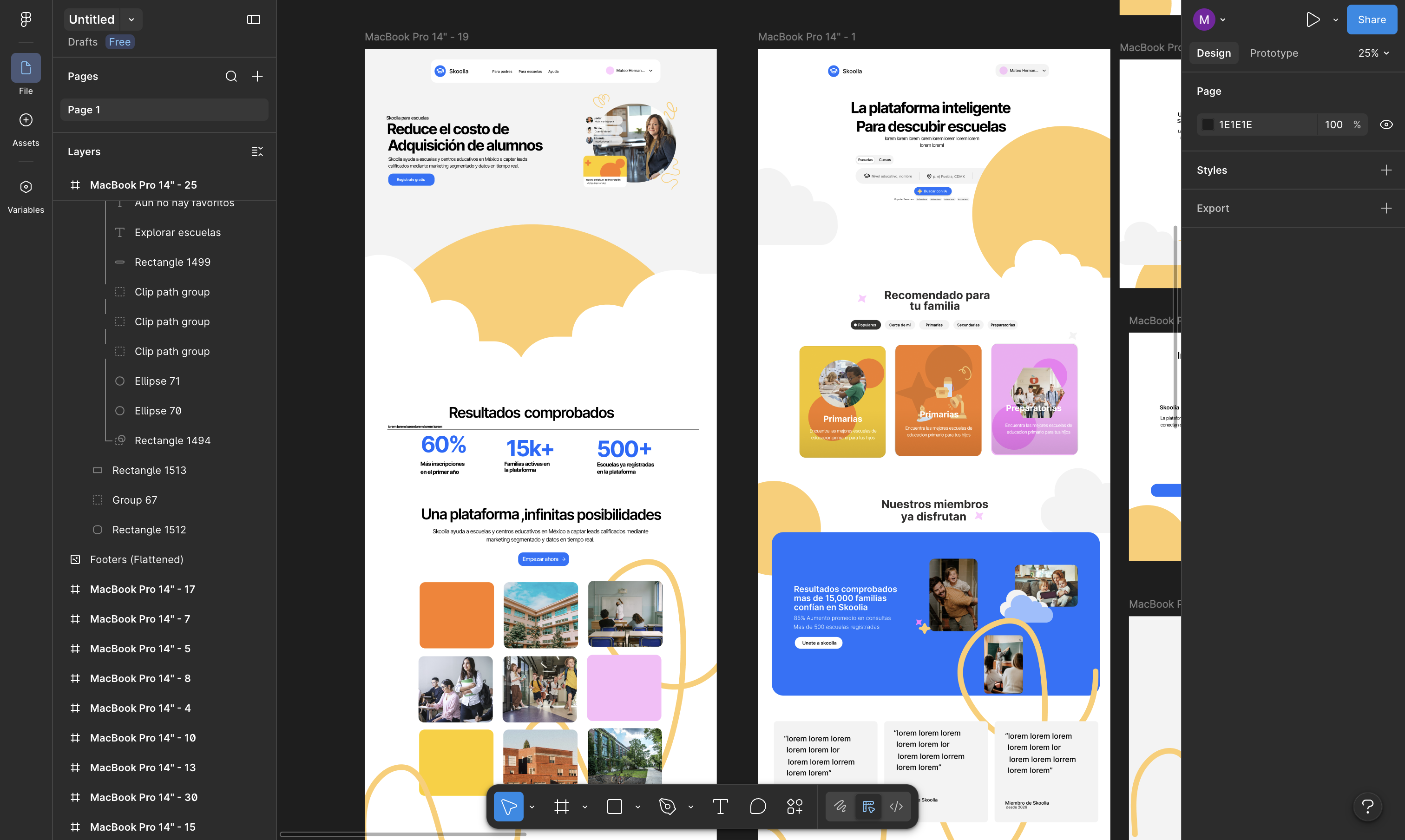
The experience was structured around discovery first: parents define what matters most — city, age, educational preferences — and Skoolia translates that into a more guided school search with clearer results and direct access to schools.
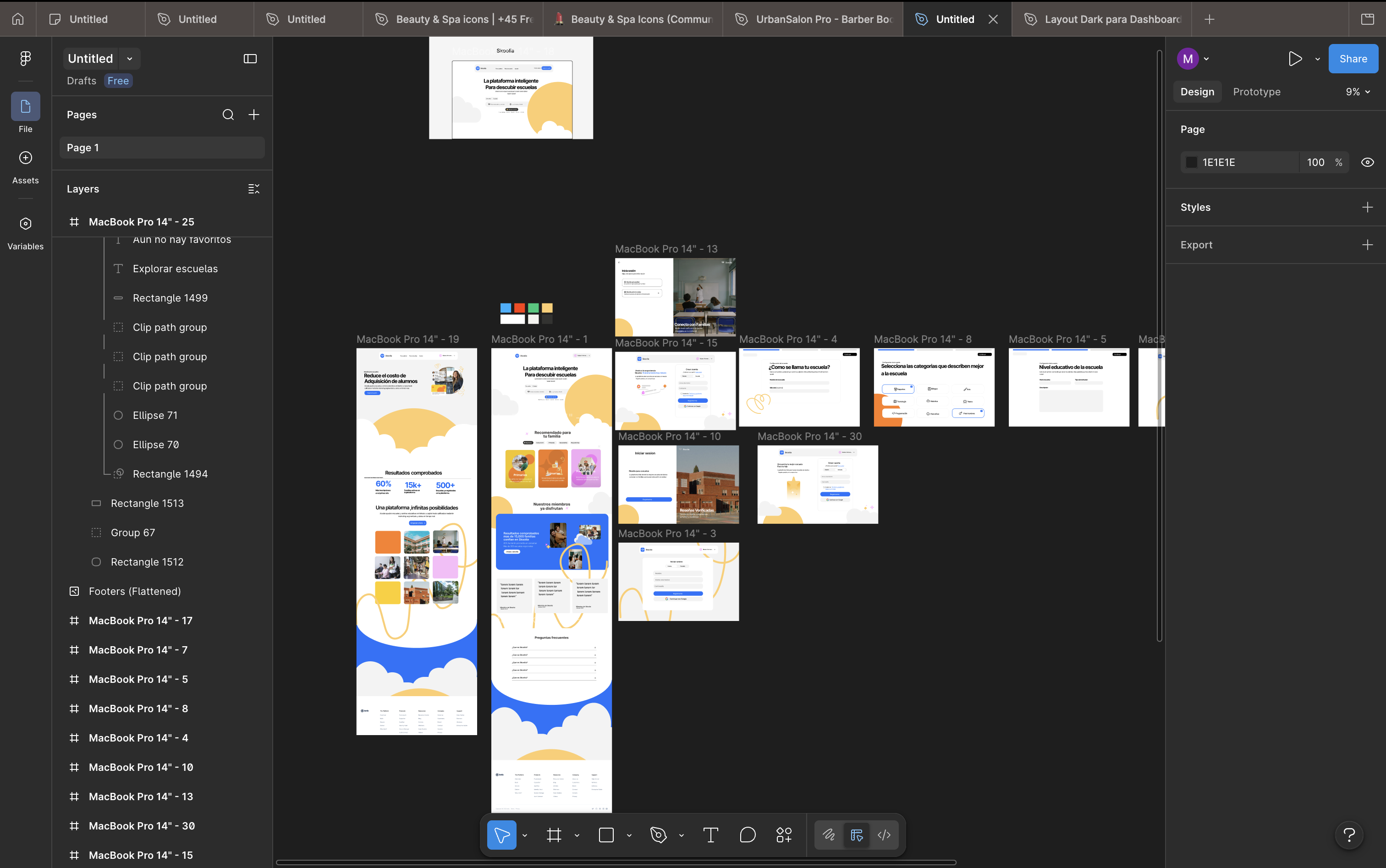
Visually, the system was designed to feel institutional but still approachable. The challenge was balancing trust and clarity with a tone that felt accessible to parents — using structured information, reusable interface patterns and a modular design system in Figma to keep the experience consistent across discovery, school profiles and admissions flows.
Skoolia was structured as a separated frontend and backend system, with the platform built around a GraphQL API, modular backend services and a relational data model designed for school discovery and admissions workflows.
On the backend, I introduced a layered architecture using a hexagonal approach to better separate business logic from transport and implementation details. More complex domains — such as school statistics and structured search — were modeled as modular feature systems, while simpler areas were kept lighter through controller-service flows for faster iteration.
The backend was designed around modular domain boundaries, with GraphQL resolvers connected to application logic in a way that kept the API layer thin and business rules isolated. This made the system easier to scale, easier to extend and less dependent on transport-level decisions as the platform evolved.
Skoolia’s data model was built around two primary actors: families and schools. Parents operated through individual accounts with profile attributes and discovery preferences, while schools managed institutional profiles, course offerings and admissions-facing information through their own account layer. The system was backed by a relational model on RDS to support structured querying and entity relationships across both sides of the platform.
The most important architectural decisions were getting GraphQL right early and structuring the platform around a clean multi-role data model. Those two decisions defined how the product scaled — both technically and from a product perspective.
The most important system in Skoolia was search. At its core, the platform depended on helping families filter through a large set of schools and narrow options down into something relevant, usable and trustworthy.
Search was designed around structured filtering rather than simple keyword discovery. Parents could narrow schools based on city, child age, educational level, school type, categories and proximity, turning what is normally a fragmented search process into a more guided discovery system.
Once a family found a relevant school, the platform transitioned from discovery into lead capture through direct school messaging and structured contact forms. This allowed interest to move directly into an admissions conversation while keeping the process more organized for both families and institutions.
My primary ownership on the systems side was centered around authentication, session handling, GraphQL structure and core backend domains such as schools and courses. I implemented the authentication flow with JWT, session persistence and refresh handling, while structuring the GraphQL layer to keep queries, relationships and domain access more predictable as the platform grew.
The most technically demanding areas were authorization, authentication state, GraphQL relationship performance and keeping school search responsive under more complex filtering conditions. Those systems defined most of the platform’s technical complexity.
Skoolia was not taken into production during my time on the project, but it was built as a complete and deployable product system ready to be continued by Aerobot and future development teams.
The platform was handed off as a structured product foundation, with the system prepared to run across environments through a containerized setup and a clearer technical baseline for future iteration. The goal was not only to build the product, but to leave it in a state that could be extended without rebuilding it from scratch.
For me, Skoolia was an important proof point in working across product, systems and collaboration. It validated my ability to build software in a team environment, contribute beyond a single engineering surface and think through both system design and product direction at the same time.
More than anything, Skoolia showed that thoughtful software can simplify how families find better educational options — turning a slower, more fragmented process into something more accessible, structured and easier to navigate.